A 36-Year-Old Relationship Systems Researcher Reveals a Simple Framework Helping Exhausted Wives Stop Carrying the Family Alone — and Rebuild Partnership Without Fights, Guilt, or Divorce

You wake up before the alarm rings. You always do.
Not because you want to. Because your brain never really switched off.
Don't forget Zee's medication... put a note in her lunchbox for the teacher... did I order the soup bowls for the weekend? Is there still bread for breakfast? The gas was low yesterday...
By 6:15 a.m., you've already solved three problems nobody even knows exist.
But if I don't think about them... who will?
Your husband is still sleeping. Not because he's lazy. He's a good man. A hardworking man. A faithful man. He has his routine. You have yours. His alarm goes off at seven. If he sleeps through it, you'll wake him. You always do.
Somehow, without anyone planning it this way, the entire household runs on your memory.
You get the children ready. You remember the school project due on Friday. You remember your mother-in-law's birthday. You remember the gas cylinder is almost empty. You remember to transfer money for the class contribution.
You remember.
You remember.
You remember.
Because forgetting is not an option.
As how? Am I the only one who remembers anything in this house?
By 9 a.m. you are at work, or building your business, or managing the home — and somewhere in the middle of it, a wave of tiredness hits you that sleep cannot fix.
It is not the kind of tired a nap solves. It is the tired that comes from being needed by everyone, and asked about by no one.
At night, when the house is finally quiet, you lie beside a man who loves you — you know he loves you — and you still feel completely alone.
If I stopped moving for just one day... would anyone notice everything I carry? Or would they just notice that dinner was late?
You are not imagining this. You are not being dramatic. You are not ungrateful for your marriage.
In a nutshell, you're exhausted because some days, you feel like a single mother... in a two-parent home.
Drop everything you are doing now, and listen to every word I'm about to say.
How do you help an exhausted married mother without tearing apart the very family she's trying to protect?
That question stayed with me for a long time.
For years, every piece of advice I found only solved half the problem. Some of it helped the marriage but forgot the woman carrying it. Other advice told the woman to choose herself, even if it meant walking away from everything she still loved. None of it felt complete.
Then a series of conversations changed everything — a conversation with my husband's aunt, a set of practical principles she shared with me, and my own observations from living inside the problem for six years. They all pointed to the same truth: the issue was never simply the husband, or simply the wife. It was the invisible structure both of them had inherited, without either one ever questioning it.
That realisation became the foundation of what is now the 3-Phase Partnership Reset Protocol. It was not created for women who want to leave. It was not created for women who want to silently endure. It was created for the exhausted married mother who still wants it all — herself, her husband, and her family.
The first thing you should know about me is that I'm not a doctor, a licensed therapist, or a certified coach. I'm a married mother, just like you, who felt like a single mother in a two-parent home for a long time and had been quietly looking for a way out of that exhaustion for years. Since finding what actually worked, I have dedicated my time, energy, and resources to testing it — and yes, it works. I am glad to finally share it with you.

Let me tell you how it actually happened, because I think you'll recognise pieces of yourself in it.
I spent fourteen years in fintech before I resigned last year to start my own business. I am good with systems. I understand structure. Hand me a business model and I can tell you exactly where it's broken.
But for six years, I could not see the structure of my own marriage breaking under the weight of invisible labour.
Years 1–2: Everything felt new. Marriage was an adventure. Yes, I managed most things, but we were building something together, and I did not mind.
Year 3: Our daughter Zainab arrived, and everything changed. Suddenly I was not just managing our life — I was managing a child's entire world. My husband, Bello, loved her deeply. He came home. He held her. But I was the one who remembered her feeding schedule, her milestones, her doctor's appointments.
Years 4–5: Ayomide arrived. Financial pressure increased. Bello paid the big bills — rent, school fees — in two transactions a year. I covered everything else: groceries, transport, healthcare, uniforms, family contributions, in hundreds of small transactions, week after week. On paper it looked balanced. In reality, the frequency of my reaching never stopped.
Year 6, I broke. Not dramatically. Not visibly. Internally. I started resenting Bello for things that weren't his fault. Intimacy quietly disappeared, not out of rebellion but out of complete emptiness. I snapped at my children a few times, over nothing. I felt invisible inside my own marriage.
I tried to fix it. I want you to know exactly what I tried, because you have probably tried the same things.
I talked to Bello directly. He listened. He apologised. He tried, genuinely, for about three days. Then the old patterns quietly returned. The problem was never his heart — it was that the structure of our marriage made it effortless to revert.
I talked to my mother. She said, "Abi, at least he is faithful. At least he provides. Many women would wish for your husband. You need to pray and endure." That conversation left me feeling more alone, not less.
I turned to my faith community, and then to online spaces. In one, I heard sermons about wives submitting and marriage requiring sacrifice. In the other, I found voices telling me my husband was the problem and that any woman who stayed was settling for less. Neither side understood that I still loved my husband, and still believed in our marriage.
I tried to do more myself. If I was just more organised, more efficient, maybe the weight wouldn't feel so heavy. I burned out instead. My energy disappeared. Nothing else changed.
I let intimacy take a back seat, thinking the distance would make Bello notice how overwhelmed I was. It didn't. It just gave him space, and the real issue — the invisible load — stayed exactly as invisible as before.
I stayed in "crisis mode" to get help. The moment I was visibly sick or completely unavailable, Bello stepped in. But I had a home to enjoy and a life to live — I couldn't stay in sick mode forever. The moment I looked strong again, everything returned to normal, and so did all the responsibilities.
I was stuck between two impossible choices: stay and disappear, or leave and break what I still loved.
Then, at a family gathering in Abuja, I met the person who changed everything, quite unexpectedly.
It was one of those busy Nigerian events — children running everywhere, food being served, conversations happening in every corner, and somehow the women quietly keeping it all together. I was doing what I always did: making sure everyone was comfortable, solving small problems before they became big ones, trying my best not to look overwhelmed.
My husband's aunt, Aunt Shazia, noticed anyway.
She didn't pull me aside for a long lecture. She simply watched me for a while, and then asked a question in Hausa that stopped me in my tracks: "Ina mijinki a cikin duk wannan?" — "Where is your husband in all of this?"
The question caught me off guard. Bello wasn't far away. Nothing appeared wrong. Yet she still asked. Was it that obvious? Could she see what I had spent years trying to hide?
She explained something I had never considered: many African men, regardless of tribe or background, are raised inside similar cultural structures. They are taught to provide, to protect, and to solve major problems — but many are never taught to see the invisible work that keeps a family functioning every single day. Not because they are bad men. Because no one ever taught them to see what they were missing.
Then she said the sentence I will never forget: "Your husband is not your enemy. But your current structure is."
She told me what we were facing was bigger than housework, money, or intimacy. It was a pattern. And patterns do not change through resentment, silence, exhaustion, or guilt. They change when both people learn to see the problem clearly, and then work together against it — not against each other.
I'll be honest with you — I didn't believe at first, because it sounded stupidly simple. A conversation, a shift, a check-in? After six years of exhaustion, that felt too small to matter.
The first few days were quiet. Nothing dramatic happened. I mapped out everything I was carrying — every invisible task, every small transaction, every mental note nobody else could see. I almost put it away, half-convinced this was just another well-meaning idea that would fade like the rest.
Then I showed Bello the map.
I watched his face change in real time. "I didn't realise you were carrying this much," he said quietly. "I thought paying the big bills was enough."
That was the breakthrough moment — not a grand gesture, not a dramatic apology, just a quiet, physical exhale I hadn't taken in years. My shoulders dropped. For the first time in a long time, I felt the smallest bit of room to breathe.
We chose our One Shift together. Bello took full ownership of bedtime, three nights a week. Not "helping" with bedtime. Owning it. I stopped managing it entirely.
Within weeks, he came to me on his own and said, "This feels different. I'm not just helping anymore. I'm actually owning part of our family."
The real test came two months in, when Bello initiated our Weekly Temperature Check without me asking. "Looking after our marriage shouldn't be your job alone," he told me. "I want to lead this with you."
By month three, I started singing in the kitchen again — something I hadn't done in years. Bello stopped, looked at me, and said, "I missed seeing you this happy." I realised then that I wasn't just getting help. I was getting myself back.
I wasn't the only one who found this. At that same gathering, two other women — cousins of Bello's, both married with young children — had similar conversations with Aunt Shazia over the years. One later told me her husband started initiating school pickups without being asked, something she said she'd stopped hoping for. Another said simply, "For the first time, I feel like my husband sees the whole of what I carry, not just the parts that are easy to see."
Six months in, partnership has become our new normal. Do we still have hard weeks? Yes. Do we still slip back sometimes? Yes. But now we have a structure that catches it early, before it turns into six more years of silence.
Since sharing pieces of this with the women closest to me, I have been flooded with the same request, over and over: "Can you just write this down for me?"
So I did.
I put everything — the full protocol, the exact conversations, the scripts, the timing, what to avoid, how to know it's working — inside one simple guide.
Introducing...
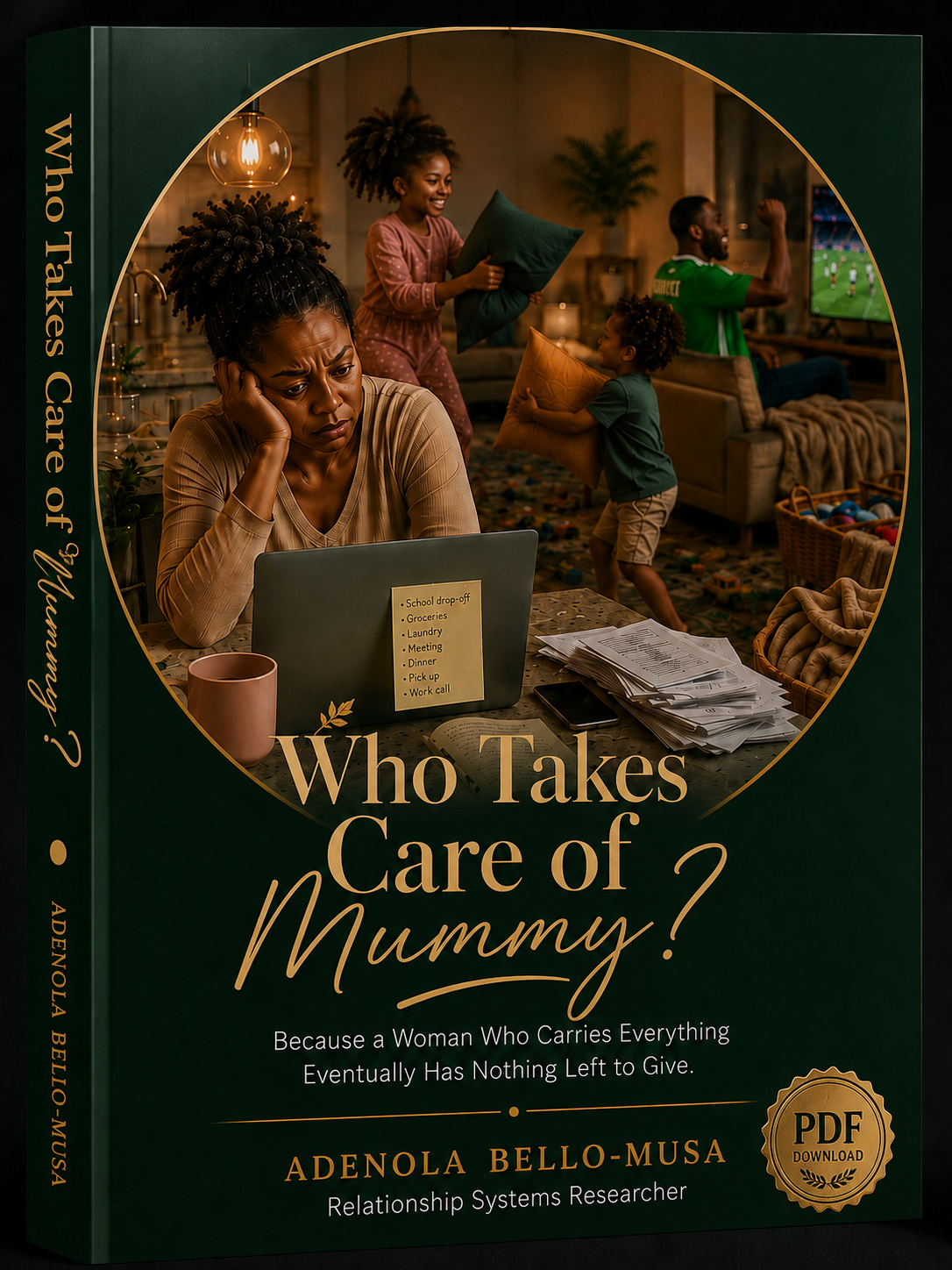
Who Takes Care of Mummy?
Because a woman who carries everything eventually has nothing left to give.
A rescue for the wife. A reset for the marriage.
A 3-Phase Partnership Reset Protocol for Nigerian wives who want to restore partnership — without leaving, without blame, and without giving up on good men.
Inside this e-guide, you'll discover:
Phase 2 alone walks you through eight practical strategies — from the Visibility Conversation to building a shared Family Culture together. Phase 3 gives you seven principles for keeping it alive, long after the initial shift.
And the best part? You don't need to threaten to leave, force a dramatic confrontation, or wait for a crisis to be taken seriously. It's the same simple method that worked for me, and has now worked for over 22 Nigerian wives I've quietly shared it with.
Real Women. Real Testimonials.
The Invisible Weight Map alone was worth the price. I showed my husband and for the first time he actually apologised without me having to explain myself for an hour. We still have work to do but this gave us language we never had.
Na the Weekly Temperature Check save my marriage o. E simple pass wetin I expect but e dey work. My husband dey initiate am himself now. I never see am coming.
As a Nigerian wife abroad, I felt like nobody understood my exact situation. This guide did. The Financial Frequency Gap section explained something I'd felt for years but never had words for.
I almost didn't buy this because I thought it was written only for wives back home. I was wrong. We have a nanny here and people assume that means I'm not carrying much — but the mental load doesn't disappear just because you have help, it just changes shape. I used the Invisible Weight Map to show my husband everything I was still managing behind the scenes, even with support in the house. He genuinely had no idea. This framework travels well, wherever you are.
I almost scrolled past because I saw it was written for Nigerian wives and I'm Kenyan, but curiosity got the better of me — and I'm so glad it did. Everything in this guide applies just as much to my marriage as it clearly does to the women it was written for. It confirmed for me that this isn't a Nigerian problem, it's a marriage problem, and the solution is just as universal. I've already recommended it to three other mums in my circle.
Just So You Know... Putting This Guide in an Easy-To-Read Format Cost Me Over ₦420,000.
- Six months of testing the protocol with 22 Nigerian wives
- Paid consultations with three licensed therapists to review the framework
- Countless conversations with my own husband, refined into scripts
- Ten fillable tools, professionally designed for print and screen
- Design, layout, and production of the finished guide
I'm not going to charge you ₦420,000...
I won't even charge you ₦210,000...
Not even ₦50,000...
In fact, you won't even pay ₦19,600.
A fair price for me would be just ₦19,600.
₦19,600 / $19.97
₦9,800 / $9.97
This Discounted Offer Is ONLY For the First 50 Buyers — After That, the Price Rises to ₦14,800. Hurry!
WAIT! I Have a FREE Gift For You...
If you're among the first 50 buyers, you'll get these amazing BONUSES alongside your package. (Today only.)
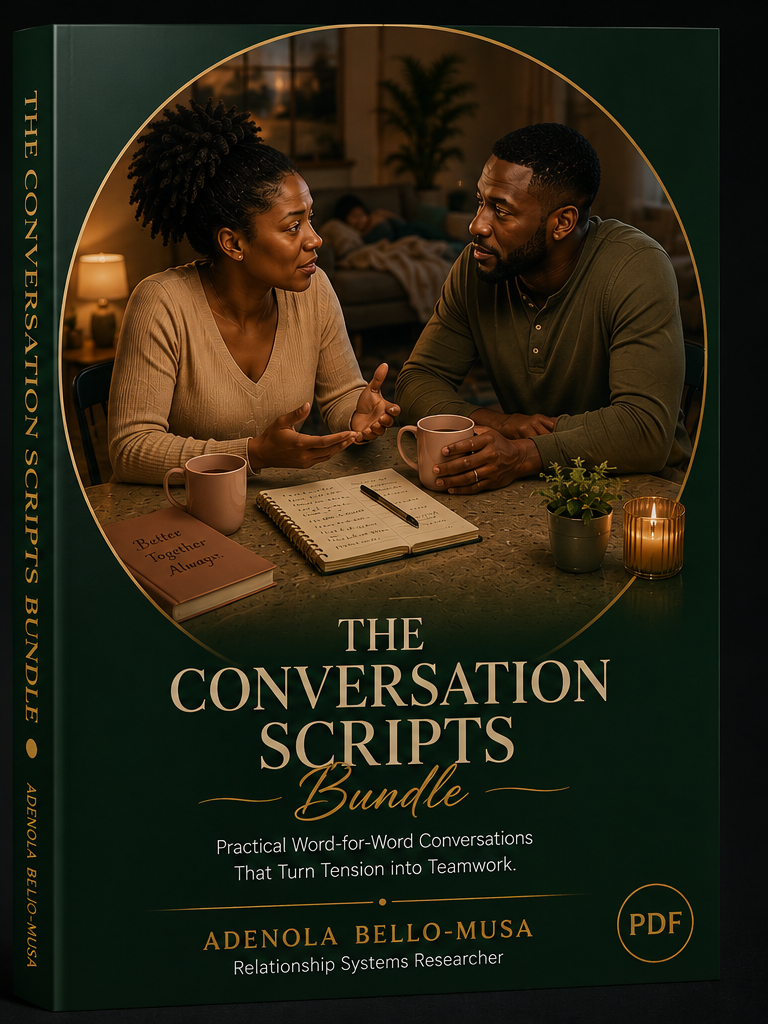
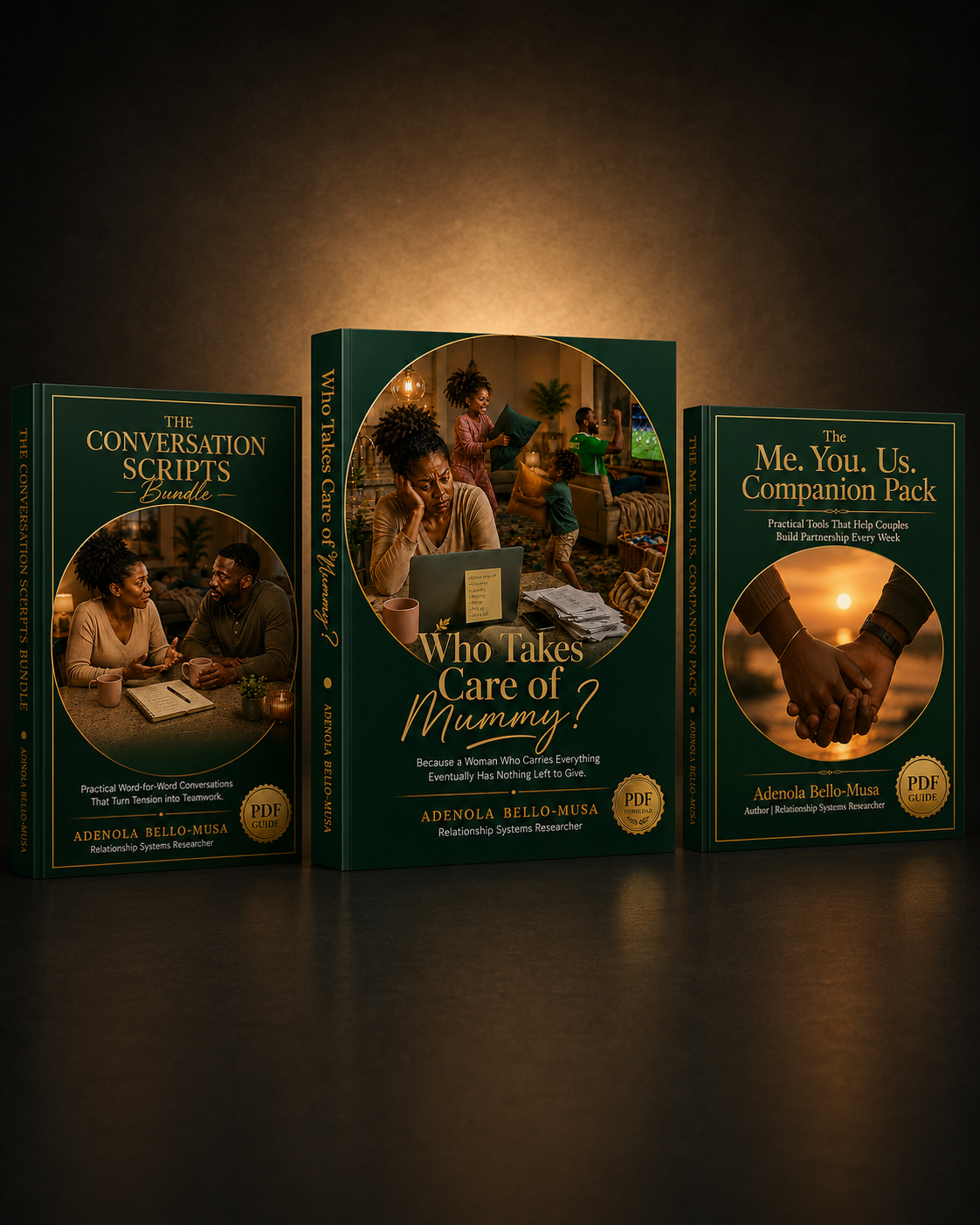
Bonus 1: The Conversation Scripts Bundle
Word-for-word scripts for the Visibility Exercise, the One Shift request, the Speaking-at-the-Right-Time codes, the Intimacy Conversation, and the Shared Ownership talk. No guessing. Just say it.

Bonus 2: The Me. You. Us. Companion Pack
Standalone, printable versions of the Weekly Temperature Check, the Marriage Dashboard, and Your Family Vision Conversation Template — formatted for your fridge, your planner, or wherever you'll actually see them. Instant download upon purchase.
Bear in mind, you're not the only one viewing this page right now.
Our Promise to You
This is a digital guide designed for women ready to take action. Purchase gives you lifetime access to the 3-Phase Protocol, all 10 tools, bonuses, and community access (where applicable). Digital products are non-refundable.
Real Women. Real Testimonials.
The mind shift alone is worth it. I never would have thought to look at my marriage this way — as a structure problem, not a "him" problem or a "me" problem. This is genuinely what therapists charge over $250 an hour for here in the US, and this guide gave it to me in an afternoon.
I don almost give up before I see this guide. Now my husband dey ask "wetin remain make I carry" instead of me dey beg am. E be like miracle but na simple structure e follow.
The Mummy Reset Monthly Reflection has become my favourite part of the month. I finally remember to check in on myself, not just everyone else.
Living abroad with the same Nigerian marriage expectations from a distance is its own kind of tiring. This guide finally spoke to my exact reality.
I buy am for myself and later buy another copy send my younger sister wey just marry. Na the kind guide wey I wish person show me since year one of my marriage.
The One Shift idea sound too simple when I first read am, but na the simplicity make my husband follow am well well. E don become part of our normal now.
Option 1: Take action. Get Who Takes Care of Mummy? And regain yourself, without losing your marriage.
Option 2: Close this page and keep questioning yourself. Keep wondering whether the problem is you, your husband, or simply motherhood. Keep carrying a weight you were never meant to carry alone, because you still don't have the words to explain it. Maybe God wanted you to see this. Who knows?
The clock is ticking.
I no even believe say one conversation fit change tin like this. My husband dey now do bedtime three times every week, no forcing, nothing. E just click for am. This guide worth every kobo.